
Magnetite Plant Upgrade in Australia: Higher Throughput at a Coarser P80
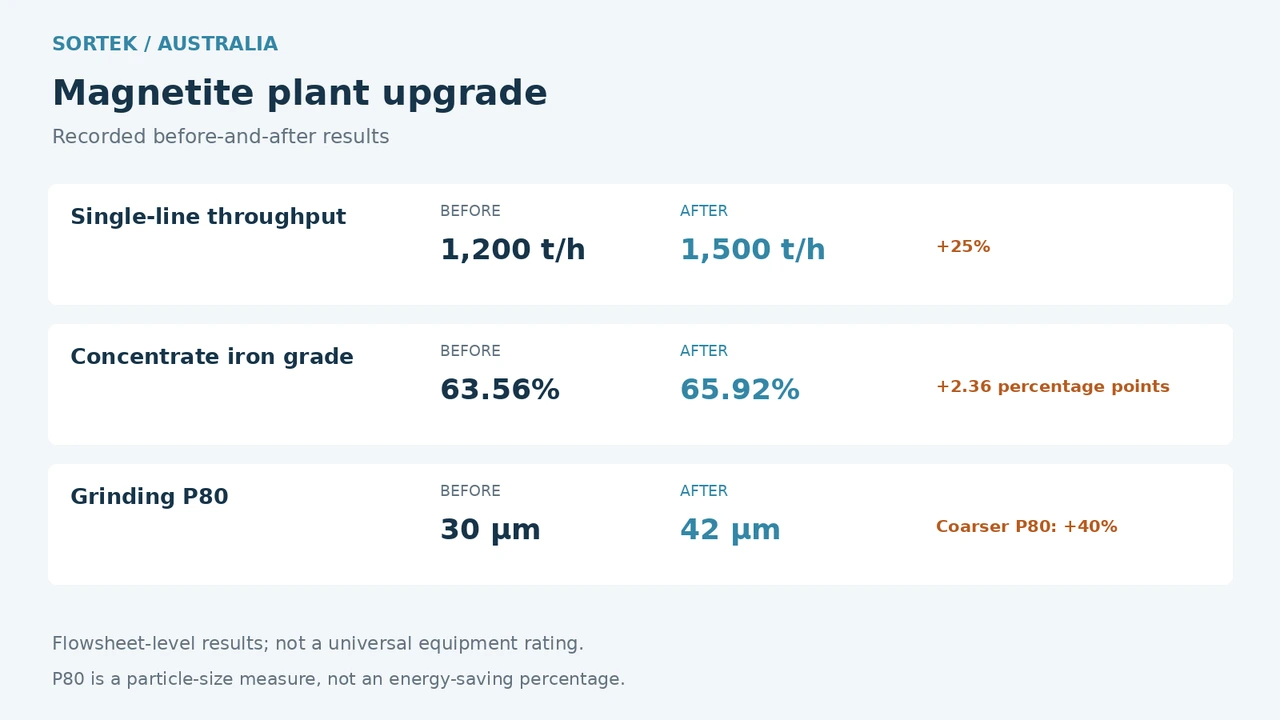
This Sortek magnetite plant upgrade in Australia combined changes to the magnetic separation flowsheet with desliming elutriation. The recorded single-line throughput rose from 1,200 to 1,500 t/h. Concentrate iron grade increased from 63.56% to 65.92%, while grinding P80 changed from 30 to 42 μm.
Why review the original magnetite circuit?
The original operation faced a combination of limited throughput and concentrate quality below its design objective. Fine grinding at a P80 of 30 μm was part of the operating constraint. The task was to review the grinding and separation circuit together, rather than assess concentrate grade in isolation.
This application concerns an existing magnetite processing plant. The throughput figures refer to one production line, not the rated capacity of an individual elutriation separator. This distinction matters when using the case to discuss equipment selection.
The magnetite plant upgrade approach
The revised route used two stages of magnetic separation followed by an automatic desliming elutriation column, replacing the original three-stage magnetic separation arrangement. The retrofit introduced the equipment progressively across the production lines.
Magnetic elutriation combines controlled magnetic fields, gravity and upward washing water. Its role in this route was concentrate cleaning and desliming. The separation outcome still depended on the mineral liberation and the feed delivered by the upstream circuit.
See the elutriation magnetic separator structure and video for the feed, water and discharge paths. Our magnetite concentrate upgrading application explains how recovery and cleaning duties relate.
Recorded before-and-after results
| Indicator | Before | After | Change |
|---|---|---|---|
| Single-line throughput | 1,200 t/h | 1,500 t/h | +300 t/h; +25% |
| Concentrate iron grade | 63.56% | 65.92% | +2.36 percentage points |
| Grinding P80 | 30 μm | 42 μm | +12 μm; coarser by 40% |
The increase from 1,200 to 1,500 t/h represents 25% more single-line throughput. Iron grade improved by 2.36 percentage points, calculated as 65.92 − 63.56. These are different measures: the grade change is expressed in percentage points, not as a 2.36% relative increase.
What does the change in P80 mean?
P80 is the particle size through which 80% of the material passes. Moving from 30 to 42 μm describes a coarser grinding product. The P80 value increased by 40%, calculated as (42 − 30) ÷ 30 × 100.
That 40% figure is a particle-size change. It does not mean electricity consumption fell by 40%. The recorded comparison shows that this circuit achieved a higher iron grade at a coarser P80, but it does not provide a verified specific-energy saving or a complete iron recovery balance.
The throughput and quality changes belong to the modified flowsheet as a whole. They should not be presented as gains guaranteed by adding one machine to any magnetite plant.
How to evaluate a comparable plant upgrade
Begin with the current flowsheet, representative feed assays, particle-size distribution and liberation information. Record dry solids throughput, slurry flow, solids concentration and wash-water availability. Define the product iron grade and impurity limits before setting a test objective.
Compare the current and proposed routes under documented feed conditions. Measure concentrate quality, mass yield, iron losses in the overflow and total recovery. If reduced grinding demand is an objective, measure power and specific energy at the relevant circuit boundary.
Use the concentrate upgrading test checklist to prepare the information. For a different cleaning objective, see our China iron-grade and sulfur-reduction case.
Discuss your magnetite plant upgrade with Sortek
Sortek manufactures magnetic separation equipment in China. Send your process information to review a proposed cleaning stage, compare the available routes and discuss the testing needed before equipment selection.