
Wet Drum Separator Capacity: Understanding t/h and m³/h
Wet drum separator capacity is commonly listed in both t/h and m³/h. These figures describe different parts of the feed duty: mass throughput and volumetric slurry flow. Before comparing models, confirm what each number includes and whether the tonnes refer to dry solids or the whole slurry.
Sortek’s wet drum catalogue includes both units in its capacity table. The two columns are useful together, but they are not interchangeable. A request for “100 tonnes per hour” still needs a defined mass basis, solids concentration and slurry flow.
What do t/h and m³/h mean for wet drum separator capacity?
| Quantity | What it measures | What to confirm |
|---|---|---|
| Dry solids throughput, t/h | Mass of solid material delivered each hour, excluding process water. | Does the quoted tonnage use a dry-solids basis? |
| Slurry mass flow, t/h | Combined mass of solids and liquid delivered each hour. | Is this the whole slurry rather than dry ore? |
| Slurry volume flow, m³/h | Volume of the solids-and-liquid mixture delivered each hour. | Does the flow include dilution water added before the separator? |
For mineral processing enquiries, dry solids tonnage is a useful starting point. However, a bare t/h value is ambiguous. State the basis explicitly instead of assuming every catalogue or supplier uses the same definition.
Why a tonnage figure does not tell the whole story
A wet drum receives slurry rather than dry ore alone. Two feeds can carry the same dry solids mass while delivering different volumes of water. A more dilute feed can therefore present a different hydraulic duty even when the dry tonnage is unchanged.
This is why selection should review both solids loading and slurry flow. The separation task also matters: roughing, cleaning and scavenging do not necessarily have the same feed composition or recovery target. See our magnetite recovery application for the process context.
How to relate slurry flow to dry solids throughput
When slurry density and solids concentration by mass are known, the relationship is:
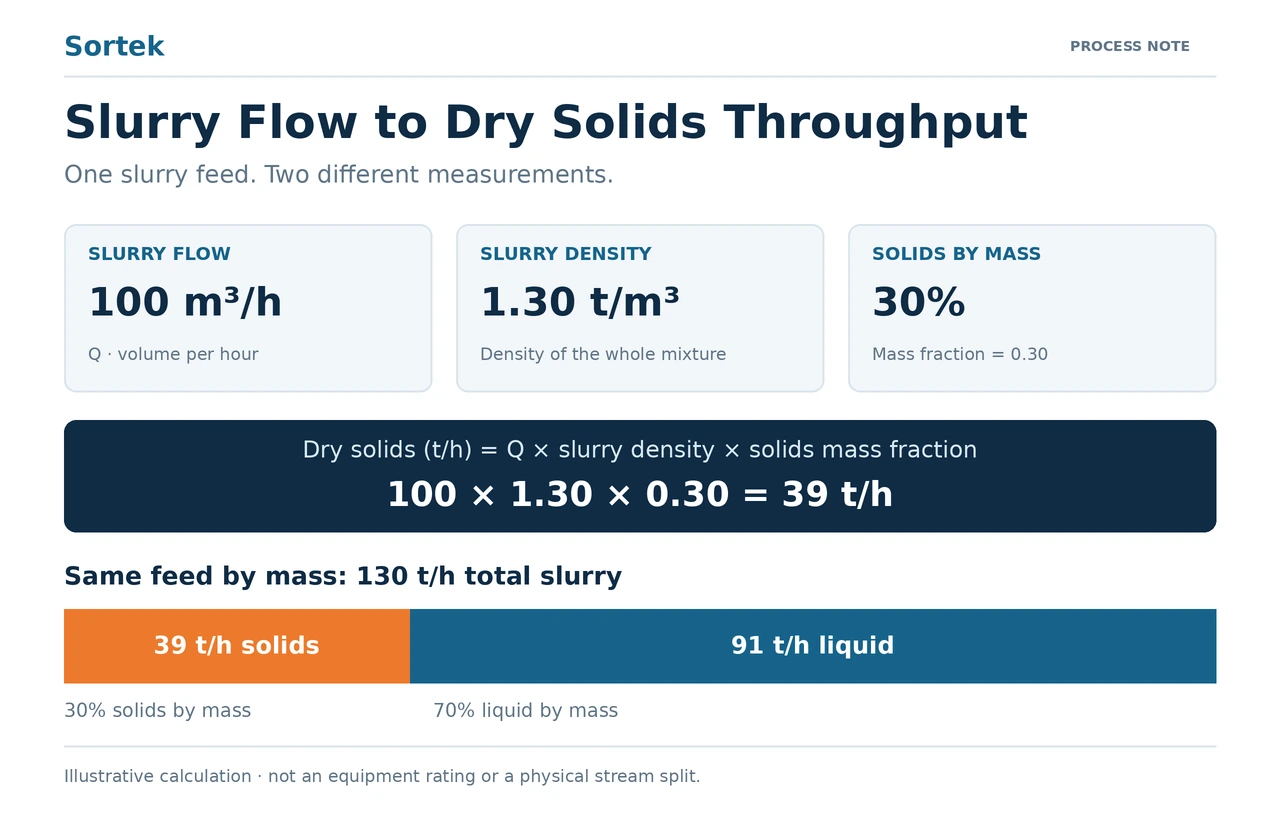
Dry solids throughput (t/h) = slurry flow (m³/h) × slurry density (t/m³) × solids mass fraction.
Use the density of the complete slurry, not the density of the mineral particles. A concentration of 30% solids by mass enters the calculation as 0.30. Solids by volume is a different quantity and must not be substituted into this formula.
| Illustrative input | Value |
|---|---|
| Slurry flow | 100 m³/h |
| Slurry density | 1.30 t/m³ |
| Solids concentration by mass | 30% = 0.30 |
| Calculated dry solids throughput | 100 × 1.30 × 0.30 = 39 t/h |
In this example, total slurry mass flow is 130 t/h, but dry solids throughput is 39 t/h. The remaining 91 t/h is liquid. These are assumed calculation inputs, not a measured plant case, a model recommendation or a guaranteed separator capacity.
If you know dry solids throughput instead, rearrange the same relationship: slurry flow = dry solids throughput ÷ (slurry density × solids mass fraction). Without suitable density and concentration data, there is no reliable universal conversion between t/h and m³/h.
Reading a wet drum separator capacity table
Read each model’s tonnage range and volume-flow range as separate reference figures. Do not pair the lower ends or upper ends to infer a fixed slurry density or concentration. The table alone does not establish the conditions behind every listed limit.
Before selecting a model from the wet drum magnetic separator range, confirm the intended operating point with the manufacturer. A catalogue range is an initial reference; the proposed duty still needs review against the feed and required separation result.
What to send when asking about wet drum separator capacity
- Dry solids throughput in t/h, clearly labelled, plus normal and peak duty.
- Slurry flow in m³/h at the separator inlet, including upstream dilution.
- Solids concentration, stating whether it is by mass or by volume.
- Measured slurry density, or the available data needed to determine it.
- Particle size distribution, mineralogy and magnetic mineral content.
- Separation stage, current flowsheet, and concentrate grade or recovery target.
If only part of this information is available, identify which values are measured and which are estimates. That makes the remaining checks clear and helps avoid comparing quotations based on different feed duties. Our wet drum selection guide covers the wider equipment discussion.
Does higher capacity mean better recovery?
Capacity and separation performance answer different questions. A throughput figure does not establish the achievable recovery or concentrate grade for a particular ore. Feed properties, equipment configuration and operating conditions must be considered together.
Likewise, recovering magnetite and improving concentrate quality are distinct tasks. If the recovered concentrate needs further cleaning, assess its impurity sources before considering magnetite concentrate upgrading. Additional cleaning is not automatically required after every wet drum stage.
Discuss your feed duty with Sortek
Sortek manufactures magnetic separation equipment in China. Send your dry solids tonnage, slurry flow and available feed data through our application enquiry page. We can review the proposed duty and discuss suitable equipment and the information still needed for selection.