
MINERAL PROCESSING · PERMANENT MAGNETIC SEPARATION
Wet Drum
Magnetic Separator
Recover magnetite from slurry. Select the drum, magnetic circuit and tank around your process.
Manufactured by Sortek in China for magnetite concentration and selected mineral-purification duties.
Discuss Your Feed ↗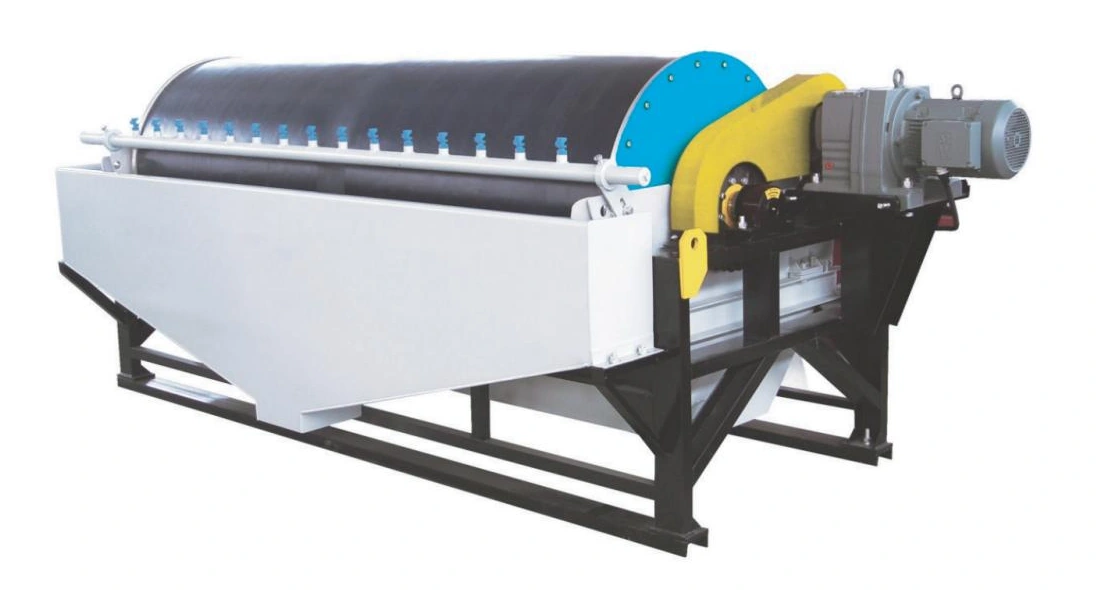
WHERE IT FITS
Magnetic recovery.
A clear duty in your circuit.
A wet drum magnetic separator uses a rotating drum and an internal permanent magnetic system to separate magnetic particles from slurry. Its role may be roughing, cleaning or scavenging, depending on the feed and circuit design.
Magnetite concentration
Recover strongly magnetic minerals from a suitably prepared slurry. Review mineral liberation and the required balance between grade and recovery.
Stage separation
Assess a drum duty within a grinding and magnetic-separation circuit. Tank arrangement, slurry loading and magnetic loading must match the proposed stage.
Initial impurity removal
For suitable non-metallic mineral slurries, assess removal of liberated magnetic iron contaminants after grinding. Weakly magnetic impurities may require a different separator.
HOW IT WORKS
Capture. Carry. Discharge.
Feed the slurry
Feed enters the tank and passes through the active separation zone. Consistent distribution helps the drum operate within its intended duty.
Retain magnetic particles
The magnetic system attracts suitable magnetic particles to the drum surface while non-magnetic material follows the tank flow.
Collect separate streams
Drum rotation carries retained material toward the magnetic-product discharge. The non-magnetic stream leaves separately for the next treatment or disposal stage.
Separate non-magnetic stream
Conceptual sequence only. Flow directions and discharge arrangements depend on the selected tank. The separator does not grind locked mineral particles.
CONSTRUCTION & OPTIONS
Match the machine to the material.
Magnetic assembly
The magnetic assembly has a stainless-steel cover, with magnetic intensity options from 1,500 to 7,000 G (150–700 mT). Confirm the proposed magnetic circuit and field measurement position.
Wear protection
Construction options include double-layer stainless drum shells or abrasion-resistant rubber-lined shells, with aluminium or stainless-steel end flanges.
Service access
The bearing arrangement uses double-row self-aligning ball bearings intended to support service access without drum disassembly. Confirm the supplied maintenance arrangement.
CTB series, with CTS / CTN options
The CTB series is available with reference specifications below. CTS and CTN tank arrangements are also available. Confirm the supplied flow drawing, drum rotation, particle-size distribution and intended roughing, cleaning or scavenging duty before selection. CTB table values should not be assumed to apply unchanged to another tank configuration.
MODEL RANGE
Wet Drum Magnetic Separator Specifications
Reference specifications for the Sortek CTB series. Capacity is shown in t/h and slurry flow in m³/h. Confirm the t/h mass basis, including whether it refers to dry solids, before sizing the separator.
| Model | Drum Ø × length (mm) | Speed (r/min) | Capacity (t/h)* | Slurry (m³/h) | Power (kW) | Weight (kg) |
|---|---|---|---|---|---|---|
| CTB-1015 | 1050 × 1500 | 21 | 38–50 | 110–180 | 5.5 | 3070 |
| CTB-1018 | 1050 × 1800 | 21 | 45–60 | 130–200 | 5.5 | 3540 |
| CTB-1021 | 1050 × 2100 | 21 | 52–70 | 150–240 | 5.5 | 4130 |
| CTB-1024 | 1050 × 2400 | 21 | 60–80 | 160–280 | 5.5 | 4720 |
| CTB-1027 | 1050 × 2700 | 21 | 70–90 | 180–320 | 7.5 | 5400 |
| CTB-1030 | 1050 × 3000 | 21 | 80–120 | 240–400 | 7.5 | 6150 |
| CTB-1218 | 1200 × 1800 | 19 | 60–75 | 160–260 | 5.5 | 5750 |
| CTB-1224 | 1200 × 2400 | 19 | 80–110 | 240–380 | 7.5 | 6850 |
| CTB-1230 | 1200 × 3000 | 19 | 100–140 | 260–460 | 11 | 8350 |
| CTB-1236 | 1200 × 3600 | 17 | 120–165 | 300–550 | 15 | 9000 |
| CTB-1240 | 1200 × 4000 | 17 | 130–180 | 240–600 | 15 | 9800 |
| CTB-1245 | 1200 × 4500 | 17 | 150–200 | 390–690 | 18.5 | 11000 |
| CTB-1540 | 1500 × 4000 | 15 | 200–300 | 500–900 | 22 | 12500 |
| CTB-1545 | 1500 × 4500 | 15 | 240–350 | 600–1000 | 22 | 14000 |
| CTB-1550 | 1500 × 5000 | 15 | 300–410 | 700–1200 | 30 | 15500 |
*The t/h mass basis requires confirmation. These are reference ranges, not guaranteed performance for every ore. Final capacity depends on feed properties, slurry concentration, tank arrangement and operating conditions. Confirm the exact configuration, installation dimensions and supplied weight in the quotation.
BEFORE YOU REQUEST A QUOTE
Start with the feed and the duty.
Material & process
- Ore or mineral type and magnetic mineral content
- Feed Fe, SiO₂ and target product specification
- Particle-size distribution and liberation information
- Position in the flowsheet: roughing, cleaning or scavenging
Capacity & plant conditions
- Required dry solids throughput, in t/h
- Slurry flow, in m³/h, and solids concentration
- Available water, electrical supply and installation space
- Current operating data and representative test results
Compare product quality with magnetic mineral losses and throughput. A higher field intensity alone does not establish the best separation result.
Prepare your test information ↗QUESTIONS & ANSWERS
Frequently Asked Questions
What is the main application?
The principal application is magnetite concentration. Suitable duties can also include initial removal of liberated magnetic iron contaminants from some non-metallic mineral slurries.
How do CTB, CTS and CTN relate?
The CTB reference series is available alongside CTS and CTN options. These involve different tank arrangements. The appropriate choice requires feed data and a review of the intended separation duty.
What feed particle size can the separator handle?
Confirm the complete particle-size distribution, maximum particle size, mineral liberation and tank configuration with Sortek. This CTB reference table does not specify one universal feed-size limit.
Are t/h and m³/h interchangeable?
No. The t/h value measures mass throughput, while m³/h measures volumetric throughput. Confirm the t/h mass basis, slurry density and solids mass fraction before comparing the two or selecting a model.
Does stronger magnetism always improve the concentrate?
No. Magnetic circuit selection must consider mineral response, liberation, slurry conditions and the required balance between recovery and selectivity. The reference field range is not a universal setting for every model or ore.
Can it replace an elutriation magnetic separator?
The two machines handle material differently. A wet drum collects magnetic particles on a rotating surface; magnetic elutriation combines magnetic retention and upward washing in a column. Compare their roles and test results for your actual circuit.
Magnetite Recovery
Review where wet drum separation fits in your magnetite circuit.
Explore the application ↗DIRECT MANUFACTURER ENQUIRY
Discuss your wet drum application.
Share your feed, dry solids capacity, slurry flow and target result. Sortek can review the proposed duty and prepare a configuration and quotation.