
RECYCLING / NON-FERROUS METAL RECOVERY
Eddy Current
Separator
Recover valuable non-ferrous metals from mixed material streams with a high-speed permanent-magnet rotor.
Explore configurations for aluminum, copper and other conductive non-ferrous metals. Start with your feed characteristics and recovery objectives.
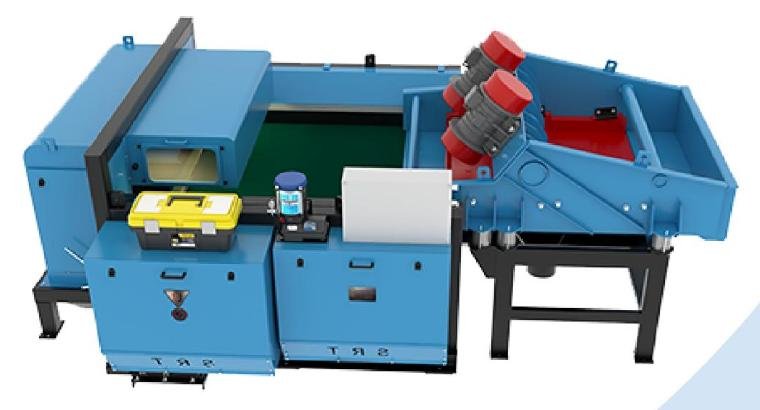
Turn mixed waste into recoverable value.
An eddy current separator uses electromagnetic induction to separate conductive non-ferrous metals from non-conductive materials such as glass and plastics. It can be evaluated as part of a recycling line after suitable screening, feed preparation and ferrous-metal removal.
HOW IT WORKS
A changing field.
A different trajectory.
01
Even Feeding
A vibratory feeder distributes prepared material evenly across the conveyor.
02
Alternating Field
The high-speed permanent-magnet rotor produces a rapidly changing magnetic field.
03
Metal Repulsion
Induced eddy currents generate an opposing magnetic field in conductive particles, changing their discharge trajectory.
04
Separate Collection
An adjustable splitter separates the non-ferrous metal stream from non-conductive material.
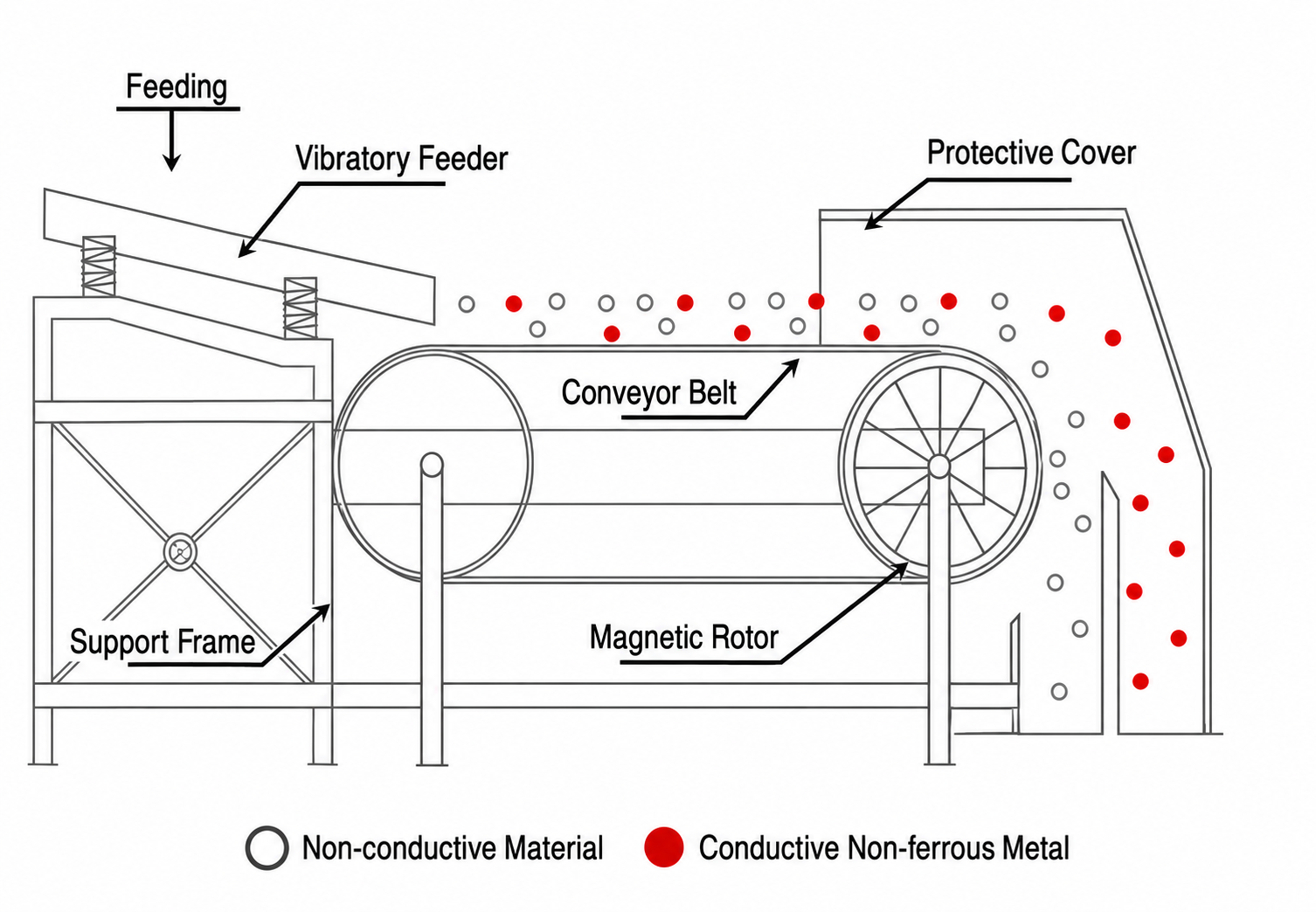
Separation response varies with conductivity, particle size, shape, density, belt speed, rotor settings and splitter position.
ROTOR CONFIGURATIONS
Match the rotor to your material.
Concentric Rotor
The magnetic rotor is centered inside the drum, creating a broader magnetic wrap. Evaluate the design against your material stream, particle size and separation objective.
Eccentric Rotor
The rotor is offset inside the drum, concentrating the active separation zone. Rotor-position adjustment supports application tuning and management of ferrous-particle accumulation.
The appropriate design requires application review. Feed preparation and upstream ferrous-metal removal remain important for reliable operation.
APPLICATIONS
Built into recycling flowsheets.
Aluminum Scrap
Recovery of aluminum, including prepared beverage-can and other aluminum scrap streams.
Glass & Plastics
Removal of conductive non-ferrous pieces, including aluminum caps, from prepared crushed glass or plastic streams.
Automotive Shredder Residue
Evaluation for aluminum and other non-ferrous recovery from screened automotive dismantling and shredder residues.
Incinerator Bottom Ash
Non-ferrous recovery from suitably processed and screened bottom ash.
Electronic Waste
Recovery stages for prepared appliance and electronic-waste processing streams.
Foundry & Municipal Streams
Evaluation of suitable casting-sand residues and sorted municipal waste fractions containing recoverable non-ferrous metals.
OPERATION & CONTROL
Adjust the process to your feed.
Adjustable Operation
Belt, rotor and splitter settings are selected around throughput and the required separation result.
PLC & Inverter Control
The brochure describes PLC and inverter control with manual, automatic and remote operating modes.
Central Lubrication
Automatic lubrication with level monitoring and pipe-blockage alarms is described in the brochure.
Line Integration
Review feeder arrangement, access for inspection, installation space and interfaces with upstream and downstream equipment.
Control scope, lubrication package, component brands and electrical requirements are subject to confirmation in the project quotation.
MODEL RANGE
Technical Specifications
Reference specifications from the supplied product brochure. Model names are retained for technical identification.
| Brochure Model | Belt Drive (kW) | Rotor Drive (kW) | Capacity (t/h) | L × W × H (mm) | Weight (kg) | Vibratory Feeder |
|---|---|---|---|---|---|---|
| HECS-65 | 2.2 | 3.0 | 3–9 | 3100 × 1840 × 1505 | 2500 | GZD-65 |
| HECS-80 | 2.2 | 4.0 | 5–11 | 3410 × 1990 × 1505 | 2390 | GZD-80 |
| HECS-100 | 2.2 | 5.5 | 7–13 | 3590 × 2230 × 1505 | 2590 | GZD-100 |
| HECS-120 | 3.0 | 5.5 | 9–15 | 3710 × 2380 × 1505 | 2755 | GZD-120 |
| HECS-150 | 3.0 | 7.5 | 11–17 | 3910 × 2690 × 1505 | 3200 | GZD-150 |
Listed capacity is a reference range and depends on material composition, particle size, feeding conditions and the required recovery and purity. Confirm dimensions, configuration and project performance before ordering.
BEFORE YOU REQUEST A QUOTE
Show us what you need to separate.
Material & Targets
Provide material origin, particle-size distribution, moisture, non-ferrous content, required throughput, and recovery and purity targets. Photos, representative samples and test results are useful.
Process & Installation
Describe existing screening and ferrous removal, feed arrangement, installation space, discharge heights, available power and control interfaces.
A uniform, thin feed layer with limited particle overlap supports separation. Narrower size fractions can simplify adjustment; fine or irregular particles require specific evaluation.
QUESTIONS & ANSWERS
Frequently Asked Questions
What metals can an eddy current separator recover?
It is used for conductive non-ferrous metals such as aluminum and copper. Separation response depends on the metal and particle characteristics; evaluate the actual feed before predicting results.
Does it remove iron?
Ferrous-metal removal is normally addressed upstream with suitable magnetic separation equipment. An eddy current separator is selected for the non-ferrous recovery stage.
What is the minimum particle size?
The supplied brochure does not specify a universal minimum particle size. Share your size distribution and representative sample so the application can be assessed.
Should I choose a concentric or eccentric rotor?
The choice depends on feed composition, size distribution, ferrous carryover and recovery objectives. A process review and material test can help determine the appropriate configuration.
Is the listed capacity guaranteed?
The listed ranges are reference values. Achievable throughput, purity and recovery depend on feed preparation and operating conditions and should be agreed for your project.
Can it be added to an existing line?
Integration can be evaluated after reviewing the current flowsheet, upstream screening and ferrous removal, installation dimensions, transfer points and control requirements.
LET’S REVIEW YOUR APPLICATION
Recover more.
Start with your feed.
Contact Sortek for technical discussion, configuration and quotation.